
What Is Mentoring?
A look at the underlying principles
Definition and Details
While traditional definitions describe mentoring simply as the act of helping and giving advice to a less experienced person, at The Mentoring School we believe this definition falls short of modern professional requirements.
True, professional mentoring is an evidence-based practice grounded in mutual trust, explicit boundaries, and psychological safety. It is a careful balance of sharing lived experience while actively enabling a mentee to discover their own capabilities and direct their own long-term career or life path.
Mentoring vs Coaching vs Teaching
To build an effective development strategy, organisations must understand where mentoring sits alongside other professional growth practices:
| Feature | Mentoring | Coaching | Teaching |
| Focus | Long-term growth and wisdom | Specific skills & performance | Knowledge transer & curriculum |
| Source | Shared ‘lived experience’ | Non-directive questioning | Structured instruction |
| Relationship | Collaborative & holistic | Task-orientated | Hierarchical (teacher/learner) |
| Outcome | Personal & professional maturity | Goal achievement | Qualification or skill mastery |
The Foundations of Effective Mentoring
Every course we offer – from Level 1 Awareness to Level 4 Advanced – is rooted in three proprietary models designed to standardise the quality of support:
1. The 5 Pillars of Mentoring: A holistic model ensuring sessions are conducted with trust and professional safety.
2. The Mentoring Flowchart: A decision-making guide to help mentors navigate the long-term journey of their mentees.
3. The Mentoring Session Model: A research-backed structure to ensure every conversation leads to a constructive outcome.
Each of these was developed by our founder, Richard Daniel Curtis, as a research-backed framework for safe, boundaried mentoring sessions that established a uniform standard for professional mentoring programmes. Indeed, they proved so effective that they are now adopted by mentoring trainers, organisations, and programmes across the world.
Bridging the gap between lived experience and evidence-based practice
Is mentoring just giving advice?
No. If mentoring were solely about advice-giving, it would be a one-way street. Professional mentoring involves active listening, strategic questioning, and building a reflective space where the mentee can analyse their own challenges. A qualified mentor guides discovery rather than simply prescribing answers.
Is your mentoring methodology based on psychological theory?
Yes. Effective mentoring draws heavily on developmental psychology, educational theory, and mental health frameworks. Our proprietary models translate complex academic research into practical, everyday tools that mentors can use to maintain boundaries and ensure sustainable progress.
Why is a 'Mental Health Led' framework necessary for mentoring?
Frontline mentors frequently encounter mentees dealing with stress, anxiety, or transition trauma. Without a mental health led framework, mentors risk crossing into counseling or experiencing personal burnout. Our framework ensures mentors can spot distress early, manage safe boundaries, and know exactly when to escalate to clinical support.
The 5 Pillars of Mentoring
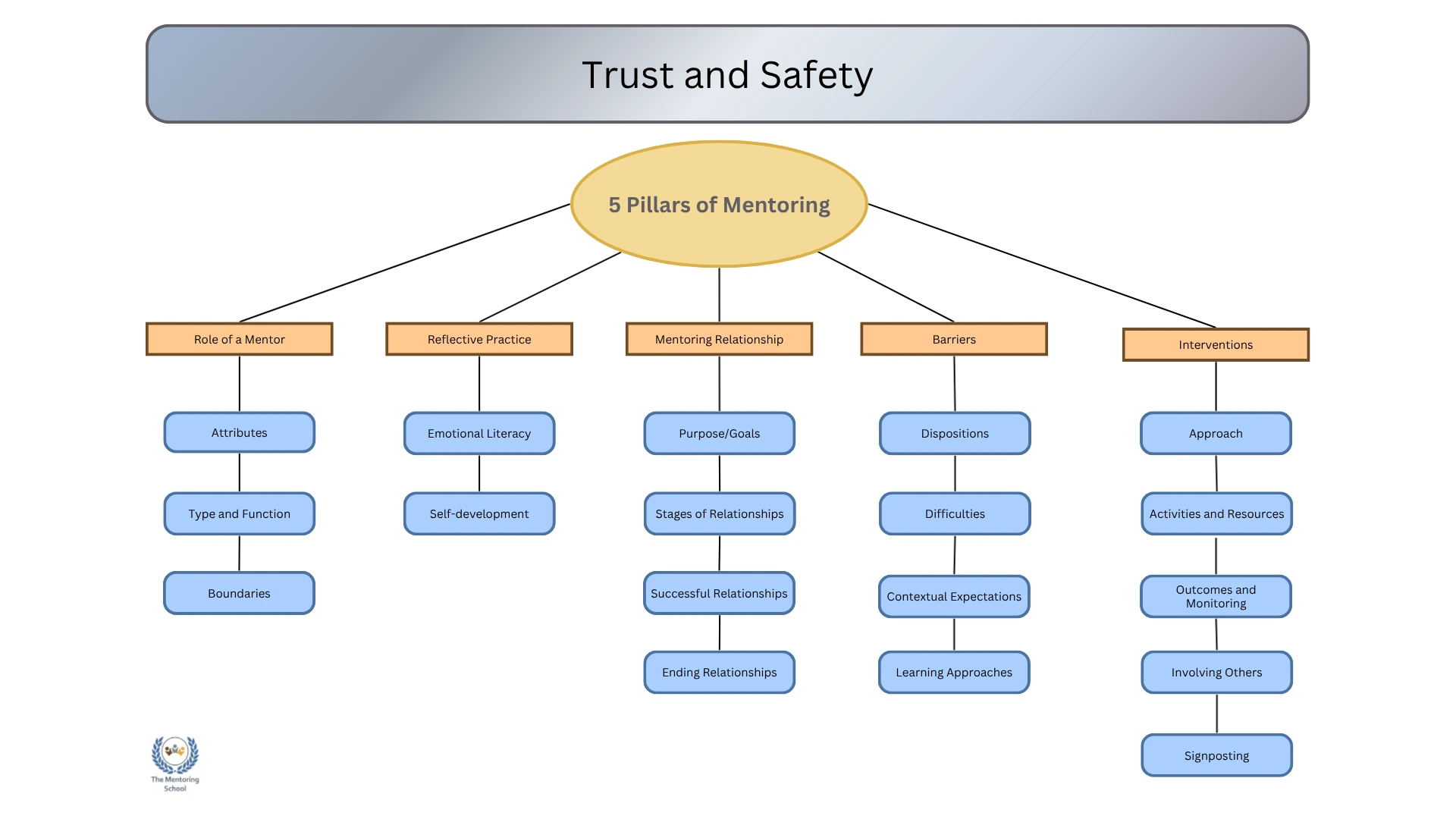
A holistic framework addressing the Role of the Mentor, Reflective Practice, the Mentoring Relationship, Barriers to Growth, and Strategic Interventions. This structure ensures all mentoring is safe and effective.
Read More
The 5 Pillars of Mentoring: Our Core Architectural Framework
To move mentoring away from unguided intuition and into an accredited, safe profession, every qualification we deliver is anchored by The 5 Pillars of Mentoring. This framework provides a structured blueprint for mentors to assess their own competence, manage risk, and deliver measurable impact.
1. The Role of the Mentor
Understanding what a mentor is—and what they are not—is the first step toward effective practice. This pillar focuses on identity and responsibility. Mentors learn to transition from directive managers or instructors into collaborative guides who use their career and lived experience intentionally, rather than accidentally.
2. Reflective Practice
High-impact mentors do not just gather experience; they analyse it. This pillar integrates formal reflective models into daily practice, teaching mentors how to evaluate their own interactions objectively. By mastering reflective practice, mentors continuously refine their communication styles and avoid projecting personal biases onto their mentees.
3. The Mentoring Relationship
At the heart of every successful outcome is a high-trust partnership. This pillar addresses the mechanics of relationship building, detailing how to establish psychological safety, manage expectations from session one, and handle power dynamics smoothly. Crucially, it teaches the art of contracting—setting clear, professional boundaries so that the relationship remains structured and safe.
4. Barriers to Growth
Mentees rarely face a smooth, linear path. Whether it is imposter syndrome, systemic organisational hurdles, transition anxiety, or learning challenges, a mentor must know how to diagnose friction. This pillar equips mentors with diagnostic tools to identify hidden barriers and co-create adaptive strategies with the mentee to overcome them.
5. Strategic Interventions
A brilliant mentoring session is defined by purposeful action. This final pillar teaches the science of the conversation itself—moving methodically from active listening and exploratory questioning into constructive action planning. Mentors learn how to deploy specific conversational frameworks to ensure every session concludes with measurable, realistic next steps for the mentee.
The Mentoring Flowchart
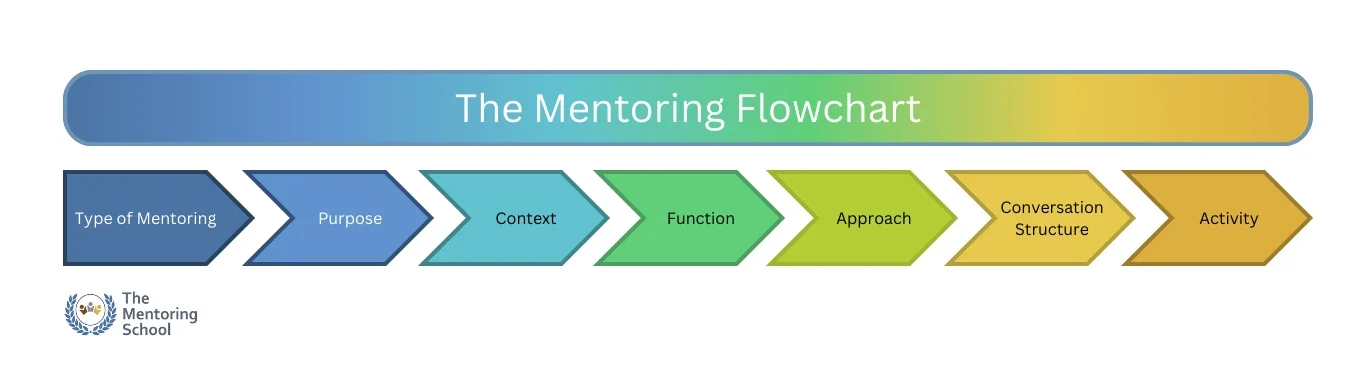
A decision-making tool that helps mentors evaluate contextual changes, manage expectations, and determine the long-term direction of the relationship.
Read More
At each stage of the relationship there are choices to be made by both mentee and mentor which will shape the way that their mentorship unfolds. Throughout the time that you conduct sessions, it is definitely worth periodically taking stock of the progress being made and considering where there may be room for improvement.
From the very beginning with selecting a specific type of mentoring, to continuously monitoring progress to inform next steps, assessing the impact of contextual changes as they occur, and responding to a mentee’s challenges, informed decision-making is at the heart of mentors’ responsibilities.
The Mentoring Flowchart was created to serve as a guideline for mentors to help them reflect on what direction and support would be most suitable for their mentee’s situation. It is designed to help them consider options in the longer-term context of the mentorship’s ultimate goals.
With each level of training completed comes deeper understanding of the influences of experience, theory, wider literature and how they affect the suitability of options.
The Mentoring Session Model
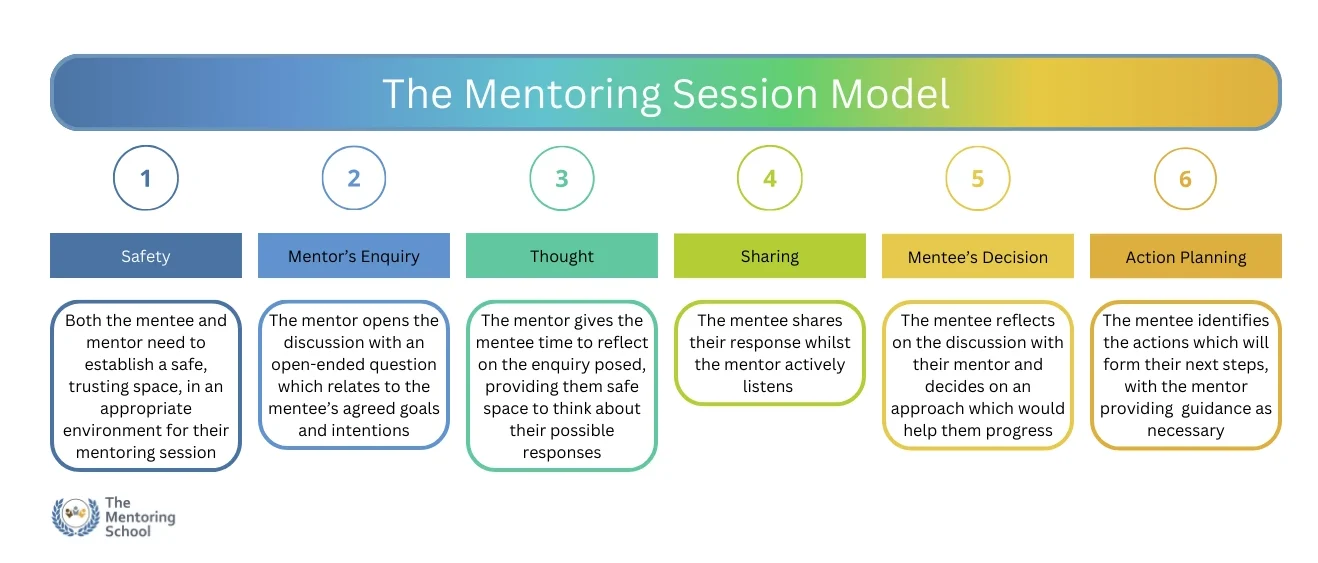
A research-backed, structured outline for individual conversations, ensuring that sessions consistently move from initial check-ins to constructive, measurable action planning.
Read More
As we said before, whilst the context of mentorships is almost limitless, there are some aspects which are shared across all practice. One of these is the fact that the fundamental structure of session conversations is in fact fairly consistent. Or at the very least, conversations need to flow through a series of stages in order to make sure that the points being discussed can be fully explored and lead to a constructive outcome.
The Mentoring Model was developed from extensive experience, research and consultation to provide a framework for the stages of conversation to deliver the effective sessions. Following this outline has proved highly effective in supporting mentors to provide meaningful support. In particular is is able to act as a structure for reference during the planning stages, helping mentors to feel confident in their contributions.
Want to master these models?
Start with our Free Basics of Mentoring course or explore our full range of Accredited Qualifications to turn these principles into a professional skill set.