
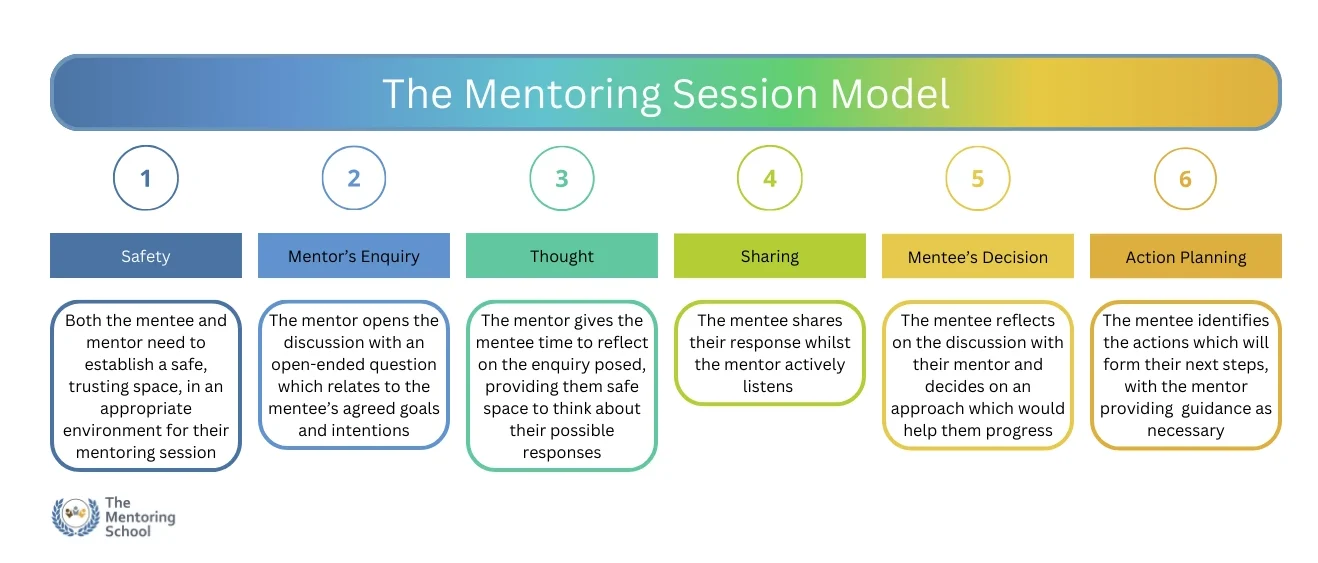
While every mentoring relationship is unique, the structure of a truly effective conversation is surprisingly consistent. Developed through extensive research, consultation, and real-world application, The Mentoring Session Model provides a practical roadmap for individual sessions.
This model was established by our founder, Richard Daniel Curtis, as a research-backed framework for safe, boundaried mentoring sessions. If has now become established as a uniform standard for professional mentoring programmes. Indeed, it has proved so effective that it is now adopted by mentoring trainers, organisations, and programmes across the world.
Originally it was known as the Mentor’s Mantra, and consisted of a four step framework: You are safe, It’s alright to think, It’s alright to talk, and Let’s make a plan. Overtime this then grew and deepened into the current six step model.
Instead of letting conversations wander aimlessly, this model ensures that every interaction flows methodically through distinct stages, maximizing exploration while moving purposefully toward an actionable result.
How the Conversation Flows: The Core Stages of the Mentoring Session Model
1. Safety: The Welcome & Check-In
Every session begins by establishing psychological safety. This initial phase is about resetting the space, building rapport, and assessing the mentee’s current emotional and mental state. Rather than rushing into business, it allows the mentor to calibrate their approach based on how the mentee is showing up that day.
2. Mentor’s Enquiry: Reviewing Progress and Opening Discussion
Accountability is a cornerstone of professional growth. Before looking forward, the mentor and mentee look back. They review the actions agreed upon during the previous session, celebrate wins, analyse any hurdles that got in the way, and reflect on the learning that occurred in the intervening weeks. The mentor then poses an open ended question relating to the mentee’s goals.
3. Thought: The Power of Space
A common mistake in informal or untrained mentoring, is the perceived need for the mentor to be the leading voice. In our model, the agenda is collaborative but led by the mentee. This stage gives the mentee the space and time to think about their answer to the question, and decide on their response without pressure.
4. Sharing: Exploration & Joint Problem-Solving
This is the engine room of the session. Here, the mentee shares their response, at which point the mentor then deploys strategic questioning and active listening to help the mentee unpack their challenges. Lived experience is shared intentionally- not as a rigid instruction, but as a contextual guide to help the mentee explore alternative viewpoints, weigh up options, and dismantle barriers.
5. Mentee’s Decision: The Reflection Point
The mentee is again given the space and time to think through everything that has been discussed in this session. They weigh up the various potential approaches and consider which approach they would prefer to take to progress.
6. Action Planning
A great conversation must translate into real-world change. The final phase of the model focuses entirely on commitment. The mentor guides the mentee to distill the exploration stage into 1–3 highly specific, realistic, and measurable next steps. The session closes by confirming these actions, ensuring the mentee leaves with clarity, focus, and a defined path forward before the next meeting.
If you would like to learn more about the mentor training available, be sure to take a look at our Course Catalogue.