
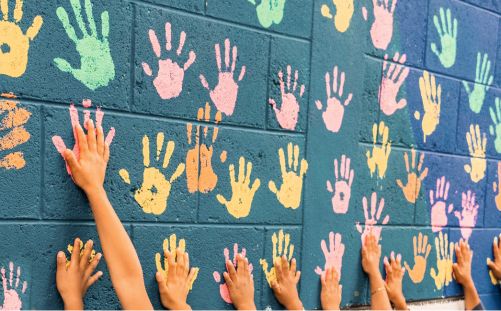
Every child deserves to feel that they have a place in this world. This doesn’t just mean a physical location, but a psychological and emotional space where they are understood without judgement. As we mark Children’s Mental Health Week, the theme, “This is My Place,” invites us to look closely at the environments and relationships that help children and young people feel secure.
As the National Children’s Bureau state, “evidence increasingly demonstrates that children and young people’s sense of belonging plays a decisive role in shaping their social, emotional, and mental health outcomes and academic performance.”
Additionally, the Education Endowment Foundation note how, within schools, “there is strong evidence that a proactive, positive and supportive approach to behaviour will benefit all pupils and can reduce the challenging behaviours.”
Fortunately, alongside schools and families who act as the primary pillars of support, there is a third, transformative force often found in the heart of our communities: the mentor. Whether through structured youth mentoring or the relatability of peer-to-peer support, mentoring provides a unique “place” for a child to simply be. As such, they are encouraged and empowered to state, “This is My Place”.
The Architecture of Belonging
For many young people, trying to find a sense of “This is My Place” can make the world feel like a series of high-stakes environments. They are tested at school, monitored on social media, and often feel the pressure to fit in rather than belong.
Mentoring shifts this dynamic, in that their role is to stand beside a young person. This side-by-side relationship creates a sanctuary of self-acceptance. When a mentor listens with empathy, they are effectively saying: “Your thoughts have value. Your feelings are valid. You have a place here.” They are giving their mentee the freedom which underpins a sense that, “This is My Place”.
Empowerment Through Stability
We often talk about resilience as the ability to bounce back, but that skill requires a stable floor to bounce off.
For a child navigating the complexities of modern life, a mentoring-informed approach provides that stability.
- Predictability: Regular sessions build a sense of relational permanence. In a world of fleeting digital interactions, knowing that a mentor will show up every Tuesday at 4:00 PM creates a psychological anchor.
- Safety to Fail: When a young person feels they belong, they feel safer to explore. Mentoring encourages positive risk-taking- trying new hobbies, expressing difficult emotions, or setting ambitious goals- because the young person knows their place in the relationship isn’t contingent on their success.
In the words of Action 4 Youth mentoring and resilience are intrinsically linked as, “through their relationship with a mentor, children learn coping mechanisms, problem-solving skills, and the importance of perseverance. These lessons help them in their current stage and as they grow in the years to come”.
This stability is fundamental for developing the child’s confidence to declare, “This is My Place”.
The Power of the Peer
Peer mentoring holds a special magic in the context of “This is My Place”. There is a specific type of validation that comes from someone who has walked the same road.
Blue Squid Learning give the example of how, “you might run a “study buddy” programme where older pupils help younger ones develop study skills while also sharing personal stories about overcoming their own anxieties. These conversations create a powerful sense of solidarity, helping younger pupils feel less alone in their struggles.”
Essentially, when a slightly older peer shares their own struggles and successes, it demystifies the path ahead. It tells the younger child: “I found my place, and I can help you find yours.” This ripple effect strengthens the fabric of the entire community, making it a kinder, more inclusive environment for everyone.
Long-Term Growth: From Roots to Wings
The benefits of finding one’s place through mentoring aren’t just immediate. Research consistently shows that a strong sense of belonging in childhood is a leading indicator of positive mental health in adulthood.
Indeed, the Centre for Early Childhood reported that, “allowing and supporting children and young people to experience and connect with the world around them, in their own unique way, is crucial. By doing this, we create environments which enable the development of the social and emotional skills that we will take with us into adulthood.”
By providing a foundation of support now, mentors help young people develop:
- Increased Self-Efficacy: The belief that they can influence their own lives.
- Social Fluency: The ability to navigate different environments with confidence.
- Community Connection: A desire to give back to the spaces that supported them.
Bringing Mentoring into the Everyday
Even if you haven’t yet completed formal mentor training, there are still ways that you can begin to adopt a mentoring informed approach. If you work with, live with, or support young people, you can help them find their place through these small, practical shifts:
- The Two-Minute Check-in: Instead of asking “How was school?” (which often gets a one-word answer), try: “What was the most interesting thing that happened in your world today?” Give them your undivided attention for just two minutes.
- Active Listening (Without Fixing): When a young person shares a worry, resist the urge to jump in with a solution. Simply reflecting back what they’ve said- “It sounds like that was really frustrating for you”– validates their experience and gives them space to process.
- Celebrate the Effort, Not Just the Result: To help develop self-acceptance, notice the ‘how’ rather than the ‘what’. Try using phrases like: “I noticed how much focus you put into that,” or “I love the way you handled that difficult situation.”
- Share Your Own Place: Be authentic. Mentioning a time you felt out of place or how you found your own confidence can help a young person feel less alone in their journey.
This is My Place
“This is My Place” is more than a slogan; it is a statement, a claim. Through the power of mentoring, we can ensure that every child feels they have a seat at the table, a voice in the conversation, and a solid foundation under their feet. When a young person knows where they stand, there is no limit to how far they can go.
To learn more about mentor training options currently available, be sure to check out our Youth Mentor and Peer Mentor training courses.