

The best mentors understand a fundamental truth of human development: true learning requires productive struggle.
When you first enter a mentoring relationship- whether as a mentor or a mentee- there is a common misconception about how the dynamic should work. It is easy to picture the mentor as a wise oracle, dispensing flawless advice, and the mentee as a passive vessel, soaking up shortcuts to success.
However, anyone undertaking high-quality mentor training will quickly discover that best-practice mentoring looks very different. In fact, you might find that a brilliant mentor routinely avoids giving direct answers at all.
This isn’t because they are trying to be difficult, evasive, or unhelpful, and for anyone currently researching mentoring schemes or preparing to embark on a programme, understanding the science and philosophy behind this approach is crucial.
Here are the reasons that the best mentors don’t just hand you the answers, and why embracing the struggle is the most effective way forward.
1. The Science of ‘Productive Struggle’
In education and cognitive psychology, there is a vital distinction between performance and deep learning. If a mentor simply tells you how to solve a problem, your immediate performance improves, i.e. the task gets done. However, no long-term learning has occurred.
When we are forced to grapple with a problem ourselves, our brains are working at their hardest. This is what cognitive scientists call productive struggle.
The Zone of Proximal Development
Coined by psychologist Lev Vygotsky, the Zone of Proximal Development (ZPD) represents the sweet spot of learning. It is the area between what a learner can do completely unaided and what they cannot do at all.
- Below the Zone: Tasks are too easy. The mentee is comfortable, but no growth occurs.
- Above the Zone: Tasks are too difficult. Without support, the mentee becomes overwhelmed and anxious.
- Within the Zone: This is where the mentor steps in. Not to do the work, but to provide the scaffolding (the right questions, prompts, and frameworks) that allows the mentee to navigate the struggle successfully.
By withholding the final answer, the mentor forces the brain to build new neural pathways. You aren’t just memorising a solution; you are engaging with productive struggle to learn the critical thinking skills required to solve similar problems independently in the future.
2. Allowing Failure as the Best Way Forward
We live in a professional culture that is often terrified of mistakes. Yet, history’s greatest breakthroughs have been built on a foundation of errors. In a mentoring context, allowing a mentee to stumble (in a controlled, supportive environment) is one of the greatest gifts a mentor can offer.
“Failure is delay, but not defeat. It is a temporary detour, not a dead end.” (John Maxwell)
When a mentor protects a mentee from every possible mistake, they inadvertently promote dependency. The mentee becomes paralysed by the fear of making the wrong move without explicit permission.
By contrast, best-practice mentoring embraces productive struggle to view failure not as the opposite of success, but as a vital part of the achievement process.
The Experiential Learning Cycle
To understand productive struggle why failure is so instructive, we can look at David Kolb’s Experiential Learning Cycle, which underpins much of modern mentor training:
| Stage | What Happens | The Mentor’s Role |
| 1. Concrete Experience | The mentee tries something and it doesn’t go to plan. | Encouraging action and experimentation. |
| 2. Reflective Observation | The mentee reviews what happened. | Asking: What went wrong? Why did that happen? |
| 3. Abstract Conceptualisation | The mentee makes sense of the experience and forms a new theory. | Guiding the connection between action and outcome. |
| 4. Active Experimentation | The mentee applies the new theory to a new situation. | Supporting the next attempt. |
If the mentor gives the answer at the start, stages 2 and 3 are completely bypassed. The profound “aha!” moment that comes from fixing a mistake is lost. Experiencing the productive struggle of encountering a setback and figuring a way through it builds resilience. And this is a quality far more valuable than any single piece of advice.
3. The Role of Psychological Safety
It is all well and good to advocate for struggle and failure, but humans are naturally wired to avoid discomfort. A mentee will not willingly step into the zone of productive struggle if they feel judged, vulnerable, or at risk of professional embarrassment.
This is where the concept of psychological safety becomes paramount. Psychological safety is the shared belief that a team (or a mentoring relationship) is safe for interpersonal risk-taking.
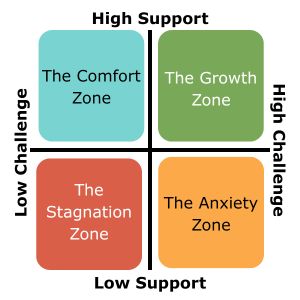
A trained mentor creates an environment where the mentee knows that not knowing the answer is completely acceptable. In a psychologically safe mentoring relationship:
- Questions are welcomed: There are no “stupid” questions, only paths to deeper understanding.
- Vulnerability is modelled: Mentors often share their own past failures to normalise the learning curve.
- The focus is on curiosity, not judgment: When an attempt fails, the conversation shifts from “Why did you do that?” to “What can we learn from this?”
When a mentee feels entirely safe, their defensive walls come down. They are no longer wasting cognitive energy trying to look perfect; instead, they can channel that energy into tackling the difficult, messy process of growth.
What to Expect From Best-Practice Mentoring
If you are currently researching a mentoring scheme, it is helpful to reframe your expectations of what a successful session sounds like.
Instead of a mentor saying: “Here is exactly what you need to do…”
Expect to hear questions like:
- “What options have you considered so far?”
- “What do you think is the root cause of this challenge?”
- “If you took that approach, what might the unintended consequences be?”
- “What is the smallest step you could take to test that idea?”
Conclusion: Embracing the Discomfort
Entering a mentoring programme with the expectation of receiving a blueprint for success is natural, but ultimately limiting. The most impactful mentors are not those who carry you to the finish line, but those who teach you how to run the race, navigate the hurdles, and pick yourself up when you trip.
By embracing the productive struggle, viewing setbacks as data, and operating within a cocoon of psychological safety, you won’t just solve the problem in front of you today. You will develop the independence, resilience, and capability to solve the problems of tomorrow.
The struggle isn’t a sign that the mentoring isn’t working; it is the exact moment that the real learning begins.
To find out more about available best-practice mentor training, be sure to check out our Course Catalogue.