
Developing Effective Mentoring Programmes
Developing a Mentoring Programme: At a Glance
-
Service: End-to-end consultancy for organisational mentoring schemes.
-
Methodology: The Four-Pillar Framework (Operations, Training, Promotion, Evaluation).
-
Key Benefits: Improved staff retention (by up to 20%), leadership development, and cultural alignment.
-
Support Level: Partnership-based (from inception to scaling).
-
Target Audience: HR Leaders, Corporate Executives, and Educational Organisations.
Why Mentoring?
With retention rates being 20% better amongst employees who receive mentoring, and around 75% of leading executives saying that mentoring played a part in their success, it is no surprise that organisations are increasingly looking for ways to create their own programmes.
However, it can be challenging for them to know how to do so most effectively.
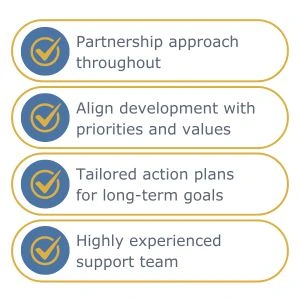
At The Mentoring School we are proud to have worked with hundreds of organisations to establish and support the development of mentoring programmes. We establish a partnership approach from the inception and planning phase, working to understand the long-term goals of the programme, ensuring that every step of the way aligns with their priorities and values.
How to Build a Scalable Mentoring Scheme
Along with tailored action plans designed to be adaptable to meet future needs, our dedicated team provide ongoing support throughout the lifespan of the project.
Read on to learn more about how we can work with you to develop a mentoring programme within your oganisation.
At the same time, feel free to download and complete our free Ready For Mentoring Scorecard to begin thinking about whether your organisation is ready for a mentoring programme.
What is the best framework for a corporate mentoring programme?
An effective programme should be built on four key pillars: Operations (policies and matching processes), Training (for both mentors and mentees), Promotion (internal communication), and Evaluation (data-driven impact analysis). This ensures the scheme is not only functional but also scalable and aligned with business goals.
The Mentoring School’s Four-Pillar Framework

Framework Details
Operations
Having a proper operational framework is vital for a mentoring programme to succeed, with best practice guidelines needing to be embedded from the foundational level.
Mentoring programmes need to have a clearly defined objective which aligns with the organisation’s goals, as this in turn informs the entire shape of the programme.
With this objective identified, we review the policies and procedures involved to provide insight and advice for making sure that they meet the needs and challenges which mentoring programmes present.
We also ensure that clear lines of support for participants are accessible at every stage of the process.
How do you match mentors and mentees in a professional setting?
Matching should be a strategic process based on complementary skills, professional goals, and shared values. As part of our operational support, we help organisations establish a robust matching framework that ensures both parties benefit from the arrangement.
Our expert teams support the organisation at every step of the way throughout operational development, deployment, and assessment. As such, our partners can be sure that their mentoring programmes are not only functional, but effective and scalable for the future.
Training
All participants in mentoring programmes need to have some degree of training so as to support ongoing best practice. For mentors this should include training on the responsibilities of their role, safeguarding, tailoring their approach to the needs of the mentee, understanding the relevant policies and procedures, and the support available to them throughout the process.
Why is mentee training important in a mentoring scheme?
Many organisations focus only on training mentors, but mentees need guidance to get the best results. Mentee training covers expectations, how to drive the relationship, and how to raise concerns, leading to higher engagement and better programme outcomes.
The Mentoring School provides training packages which meet all of these criteria, with varied levels to best match the experience of those involved. We are also able to further tailor modules and delivery according to the specific needs and goals of an organisation. This includes options for Continuing Professional Development for programme participants, allowing them to improve their range of skills over time.
Promotion
In order to have an effective mentoring programme, it is important that participants are clear from the start as to the aims and expectations involved. This allows people to confidently engage with the opportunity and improve outcomes. Therefore, a key step is to have a plan for internal and external communications which makes this information clear whilst encouraging participation.
Take for example, an organisation seeking to establish a mentoring programme with the aim of upskilling its teams to address skills gaps. They would need to identify the specific skills which need development, as well as the target audience for this initiative, in order to ensure that promotional communications can be as effective as possible.
Evaluation
Analysing the impact of a mentoring programme is a key part of the overall process, with ongoing monitoring of progress and experience being essential for guiding the development of the initiative.
How do you measure the success (ROI) of a mentoring programme?
Success is measured through the Evaluation pillar. This involves regular check-ins and gathering data on progress against the programme’s original objectives, such as improved retention rates, employee satisfaction scores, or the closing of specific skills gaps.
Linking to the operations elements, we help to establish systems for these regular check-ins, as well as encouraging feedback from all participants. This allows organisers to closely monitor the progress of mentorships, making sure that all involved are in fact benefitting from the arrangement and wish to continue. Moreover, gathering this data and tracking responses over the course of the programme is vital for analysing the outcomes against the stated goal of the programme, and informing projections for model scaling.
Comparison: Internal vs. Consulted Programmes
| Feature | DIY Mentoring Scheme | Partnered Programme With The Mentoring School |
| Strategy | Often ad-hoc or informal | Structured Four-Pillar Framework |
| Training | Variable or missing | Accredited, bespoke training for all |
| Sustainability | High risk of ‘burnout’ | Designed for scalability and longevity |
| Evaluation | Anecdotal feedback | Data-driven impact analysis |
Transform your organisational culture through structured mentoring
Whether you are launching a pilot scheme or scaling an existing programme, we provide the framework and expertise to ensure success.