

Free Basics of Mentoring Course at a Glance:
- Cost: Free to access.
- Duration: Under 2 hours.
- Format: 4 Video Modules + Workbook + Quiz.
- Certification: Optional CPD Certificate (£36).
- Level: Introductory / Awareness.
- Entry Requirements: None—perfect for beginners.
What You Will Learn
Our free mini-course is designed to strip away misconceptions and provide you with a solid foundation in mentoring theory:
- Part 1: Building a Trusting Relationship – How to establish the core foundation of any mentorship.
- Part 2: Relationship Dynamics – Understanding different types of mentoring and how to end a relationship professionally.
- Part 3: Good Practice for Mentors – Mastering the practicalities and ethical standards of the role.
- Part 4: Ethics & Awareness – A deep dive into confidentiality and identifying unconscious bias.
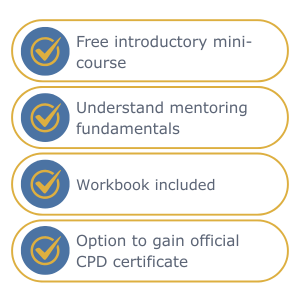
After watching the videos you can take the course quiz to test your knowledge and understanding of what you have covered. You will also have the option to pay to download the official CPD certificate.
Free Training vs Full Qualification
| Feature | Basics of Mentoring (Free) | Accredited Level (1/2/3) Qualification |
| Depth | Introductory/Awareness | Comprehensive/Practitioner |
| Time | 2 Hours | 30-50 Hours |
| Certification | Optional CPD Certificate | Regulated Qualification (Level 1/2/3) |
| Ideal For | Curiosity & Basic Skills | Professional Career Progression |
| Cost | £0 for course videos | From £360+ |
Is this mentoring course really free?
Yes. You can access all four video modules and the accompanying workbook entirely for free. This allows you to gain a basic understanding of mentoring principles without any upfront financial commitment.
How do I get a certificate for this course?
Once you have watched the videos and completed the course quiz to test your knowledge, you have the option to pay £36 to download an official CPD Certificate. This provides formal evidence of your learning for your professional portfolio.
Do I need prior experience to take this training?
Not at all. This course is specifically designed for those who are new to mentoring or are considering getting involved in a programme. It is a perfect “first step” before pursuing a fully accredited Level 1 or Level 2 qualification.
Can I use these skills if I don’t become a formal mentor?
Absolutely. The principles of active listening, building trust, and understanding boundaries are universally applicable in management, teaching, and daily professional life.
Research has shown that people with mentors are happier in their current jobs than those without. Therefore, being able to begin applying the basics of mentoring principles in daily life can have a real, positive impact on your personal and professional spheres. Even if you decide to not pursue becoming a fully qualified mentor, the skills and principles involved are universally applicable.
That being said, there can be many misconceptions about mentoring. Often people think that all is required is to have some relevant experience and a passion to share. Unfortunately, this can lead to people thinking they are mentoring, when actually they are either telling others what to do (instructing) or passing on skills (teaching). Being trained in the basics of mentoring is a vital step for anybody looking to provide this type of support, whether as a formal or informal arrangement.
As such, if you have ever wondered- just what is mentoring? How do you structure a mentoring conversation? Then The Mentoring School’s free Introduction to the Theory of Mentoring mini-course is the place to start. Whether you are thinking about getting involved in a mentoring programme or are simply curious to learn more about how it all works, this training is the perfect place to start.
Get Started Now
Theory of mentoring in action
Mentoring as a process puts the mentee at the very center of the work – the mentee sets the agenda and takes ownership of the agreed outcomes.
To enable this, the mentor needs to make informed decisions about the approach they will take, such as how much of their own experience to share depending on the mentee’s goals. Effectively engaging with this process does require a measure of understanding about the overarching journey of mentorship, along with relevant roles and responsibilities. Mentoring always has a purpose in mind- a goal that is being worked towards- and this needs to be the guide for setting expectations and structuring sessions.
Part 1 – Building a Trusting Relationship
Part 2 – Types of Mentoring and Ending a Mentoring Relationship
Part 3 – Good Practice for Mentors
Part 4 – Confidentiality and Unconscious Bias
Once you have completed this free mentor training, feel free to click below to take the quiz and test your knowledge. You can also pay to download the official CPD certificate for £36.
Enjoyed the basics?
Take your skills to the next level. Explore our Full Course Catalogue to find sector-specific qualifications in Education, Healthcare, or Business mentoring.