
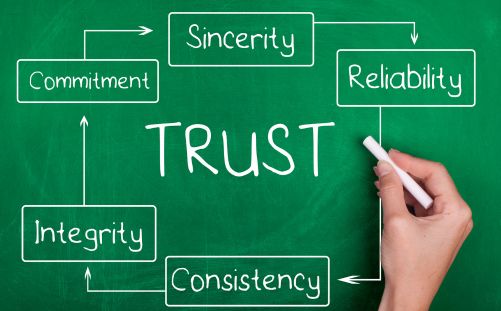
In mentoring, we often state that trust is the bedrock of an effective relationship. It’s the essential foundation upon which vulnerability, growth, and honest feedback can stand. But step outside the one-to-one dynamic of mentorship, and you realise that building trust becomes exponentially more vital in the wider world.
Trust isn’t just a nice-to-have; it’s the social glue that allows societies, economies, and organisations to function efficiently. When trust is high, transactions are smoother, collaboration is effortless, and communication is direct. When trust is eroded, everything slows down, becomes more costly, and is fraught with suspicion.
In a world increasingly saturated with information (and, crucially, misinformation) the ability to discern a trustworthy source or individual is a survival skill. Anxiety around “fake news” and compromised data highlights a widespread crisis of confidence.
As the 2024 Edelman Trust Barometer revealed, “The mass-class divide, the huge imbalance in trust between business and government and the infodemic have been the forces behind the decline in trust and polarization.”
This makes the deliberate and demonstrable act of building trust, both personally and professionally, one of the most powerful things an individual or organisation can do today.
The Universal Impact of Trust
Trust operates on several crucial levels, impacting every aspect of our lives and relationships:
1. Individual and Interpersonal Trust
At a personal level, trust is fundamental for developing deep relationships. It reduces the need for constant checking and verification. Building trust with a colleague means you delegate with confidence. When you trust a friend, you share your vulnerabilities.
This mutual faith allows individuals to take risks, learn, and grow faster. It fosters psychological safety – the belief that you won’t be punished or humiliated for speaking up with ideas, questions, concerns, or mistakes. As Mindtools describe, “The psychological contract – the unspoken agreement of mutual respect, trust, and fair treatment – is fundamental to creating a high-trust culture.”
2. Organisational Trust
For businesses and institutions, high levels of trust internally and externally translate directly to the bottom line.
- Internal: Employees who trust their leaders and colleagues are more engaged, productive, and loyal. They are more likely to share knowledge, innovate, and work through complex problems collaboratively. In fact, Harvard Business Review reported that “employees in high-trust environments report 74% less stress and 50% higher productivity.”
- External: Customers who trust a brand are more likely to purchase from them and become fierce advocates. According to research by Gartner, 83% of consumers say they will not do business with brands they don’t trust. Trust acts as a powerful brand differentiator, especially in today’s highly competitive, global markets.
3. Societal Trust
On a macro scale, trust in institutions – governments, media, scientific bodies – is essential for public health, stable governance, and economic stability. When this trust falters, societies become fragmented, prone to rumour, and resistant to necessary collective action.
Practical Ways of Building Trust
Building trust is not a single action but a persistent, deliberate pattern of behaviour. It is built on three main pillars: Character, Competence, and Consistency.
A. Individual Action: Establishing Your Character
For an individual, establishing yourself as trustworthy requires continuous self-monitoring and commitment to ethical conduct. As The Grossman Group summarises: “It comes from a conscious effort to walk your talk, keep your promises, and align your behavior with your purpose and values. “
1. Lead with Integrity
- Honesty: Always tell the truth, even when it is difficult or uncomfortable. Trust breaks down faster over small, unnecessary lies than over large mistakes handled transparently.
- Values: Be clear about your personal values and ensure your actions are aligned with them. If you value punctuality, arrive on time. If you value respect, listen actively and without interruption. This demonstrates that you are reliable and predictable in a positive way.
2. Honour Commitments
- Deliverables: Do what you say you’re going to do, when you say you’re going to do it. If you cannot meet a commitment, communicate this proactively, not reactively, and offer a new, realistic deadline.
- The Power of Small Promises: Trust is often built by faithfully keeping minor commitments, like turning up for a meeting on time or following up on an email. These small wins accumulate.
3. Practise Transparency and Humility
- Openness: Be open about your motives and processes where appropriate. In a world suspicious of hidden agendas, visible processes build confidence.
- Own Mistakes: When you make an error, acknowledge it quickly, take responsibility, and focus on fixing the issue rather than assigning blame. Humility shows that your focus is on the greater good, not your personal image.
B. Organisational Action: Cementing Trust Institutionally
It should be noted that one thing which organisations can do to help with developing their reputation and building trust can be by pursuing accreditation. Just as an individual can be vouched for by another and so benefit from a transference of trust, companies and brands can be externally vetted and approved. (Explore accreditation further).
Essentially, organisations have a responsibility to design systems and cultures that support the building and protection of trust. This is particularly difficult when dealing with public scepticism over data privacy and information integrity. Key steps include:
1. Champion Radical Transparency
- Information Sharing: Be open about successes and failures. Instead of spin, explain the ‘why’ behind major decisions. Companies that openly discuss operational challenges or product flaws often earn more trust than those that project an image of infallible perfection.
- Data Ethics: Be absolutely clear and rigorous about how customer data is collected, stored, and used. Go beyond minimum legal requirements; articulate a clear ethical stance on data privacy.
2. Prioritise Internal Consistency
- Fair Process: Ensure policies (promotions, performance reviews, disciplinary actions) are applied fairly and consistently across all levels of the organisation. Nothing erodes employee trust faster than a perceived double standard.
- Leadership Alignment: Leaders must not only talk about the company values, but visibly live them. If leaders are exempt from rules, the organisation’s message of integrity is nullified.
3. Build Digital Trust Defences
Zendesk describe how important it is to “tout your company’s commitment to privacy and protection. Explain how customers’ private information will be protected, especially from threats like data breaches. This helps customers feel reassured.”
Frankly, in today’s landscape of misinformation, organisations focussed on building trust must proactively protect their digital integrity, such as by:
- Verifying Sources: For any information published, make sure original sources are cited and verifiable.
- Combatting Misinformation: Have a clear, rapid-response strategy for addressing false information about the organisation or its products, backing up all rebuttals with clear, demonstrable evidence.
The Continuity Imperative: Why Trust Takes Time
The most crucial element of building trust is continuity. Trust is not a one-time achievement; it’s a living entity that requires constant nourishment. The age-old adage holds true: “trust takes years to build, seconds to break, and forever to repair.”
Trust is built in drops and lost in bucketfuls.
Nietzsche once stated, “I’m not upset that you lied to me. I’m upset that from now on I can’t believe you.”
The difficult truth is that any lapse in the actions outlined above – a broken promise, an act of dishonesty, a moment of inconsistency – can rapidly dismantle years of effort.
- Commitment Over Time: The real power in trust-building comes from the relentless repetition of ethical, competent behaviour. A single act of integrity is admirable; a decade of consistent integrity is the definition of trustworthiness.
- The Multiplier Effect: Consistent behaviour acts as a trust multiplier. Over time, people move from hoping you’ll do the right thing to expecting it. This expectation of integrity is the highest form of trust.
Conclusion: Your Trust Legacy
Whoever you are, whether thinking of your personal or professional life, the work of building trust is a deeply worthwhile investment.
In a world struggling to find its footing amidst rapid change and information overload, becoming a reliable, consistent, and competent source of truth is your greatest contribution. Trust is the foundation of every strong relationship, the engine of every successful business, and the lifeblood of a healthy society.
Start building trust today. Honour your small promises, tell the difficult truth, and commit to the long-haul of consistency.
To learn more about how building trust and effective mentoring are fundamentally linked, take a look at our What Is Mentoring? page.